Showing posts with label Myths and Legends. Show all posts

Monday, 11 February 2013

February Lovers 1: Tristan & Iseult (Isolde)

This week's tale stems from a Arthurian legend.  It's the tale of Tristan & Iseult.  It's another cautionary tale of course and a fascinating one. I heard first when I was little and I haven't stopped loving it since.  It's the Celtic Romeo & Juliet before Shakespeare was even a thought.
Herbert Draper 1863-1920
Isolde was a golden haired  Irish Princess, who healed the orphan Tristan of a serious side wound, a lingering ailment similar ot the one affecting the "Maimed King" in the story of the Grail.  In these times a maimed man could not rule as King, so when Tristan was to be named his heir by his uncle King Mark of Cornwall, his advisers protested.  King Mark gave in, and decided he would marry the woman whose hair had fallen from the swallow's beak.

Sire Tristan recognizing the hair as belonging to Isolde, decided to champion his Uncles' cause for her hand.  When he reached Ireland he discovered her home being terrorized by a dragon.  Knowing the best way to get her hand for his uncle was to get rid of the beast, Tristan tracked it home & fought it. It was a hard battle and Tristan was greatly wounded, being knocked out by the beast's poisonous breath as it died.

While he was out another man attempted to claim the victory but Isolde & her mother sensed that there was something wrong with his story & went seeking the true hero & found Tristan   While nursing him back to health Isolde realized that Tristan's sword was missing a piece, a piece that matched exactly the metal found in the head of Morholt, Ireland's champion. Furious, Isolde attempted to kill him, but found that her heart wouldn't let her kill him.  It came as a shock, when recovered Sir Tristan asked for her hand on his Uncle Mark's behalf & her father agreed as a way to heal the wound between Ireland & Cornwall. Iseult however was still upset at this. Knowing her daughter would need a happy marriage, her mother made a love philtre meant for Iseult & King Mark to drink & gave it to her maid Brangaine.  If the potion was drank on their wedding night it would make the couple love each other forever.  All would have been well if Tristan hadn't accidentally drank some & shared the goblet with Iseult on the journey to Cornwall.
John Duncan's Tristan & Isolde canvas, 1912
Although Iseult married the King, on the wedding night, under the cover of darkness Brangaine took her place in the royal bed so the he would suspect nothing.  For a while the lovers managed to maintain their affair before they were discovered.  King Mark found the lovers asleep with Tristian's sword lying between them, he decided not to slay them then & there, but exchanged his sword for Tristian's.

When Tristan woke he was stunned & overcome by the mercy shown by his uncle, Tristan persuaded Isolde to return to her husband & he volunteered himself for exile in Brittany.  There in Brittany, he married but it was not a happy marriage, because the bride Iseult of the White Hands, loved her husband more than he could love her.  Several times in secret he would sneak back to Cornwall and met with Isolde in secret, but the war in Brittany kept him too busy to return often. During a battle Tristan was severely wounded & sent for Isolde.  He asked his friend & fellow Knight to sail back with her under a specific set of sails.

Their code was for Isolde to sail under a white flag when she was close. If the Knight was returning without Isolde to sail beneath a black sail.  Jealous & angry at the imminent reunion of the lovers, Tristian's Bretton wife Iseult of the White Hands, told him that the ship was sailing beneath a black flag.  Losing his will to live, Tristan threw himself on his sword & died before Isolde could reach him.  Heartbroken, Isolde followed him into death not much later.

When they were buried, a hazel tree and a honeysuckle bush sprung up & grew together.  Three times King Mark had the branches cut back to separate them and each time they grew back together. Eventually he left them alone.

The End.
@Britannia Travel website
The Tristan stone: on the Britannia travel site gives a great tourist guide to the stone & places from the legend.
"The Tristan Stone (from Wikipedia)  Known as The Tristan Stone, or The Longstone (Cornish: Menhir, meaninglong stone), is a 2.7 m tall granite pillar near Fowey in Cornwall. The stone has a mid 6th century AD two line inscription which has been interpreted as reading DRVSTANVS HIC IACIT CVNOWORI FILIV’S (‘Drustan lies here, of Cunomorus the son’). A now missing third line was described by the 16th century antiquarian John Leland as reading CVM DOMINA OUSILLA (‘with the lady Ousilla’). Ousilla is a Latinisation of the Cornish female name Eselt, otherwise known as Isolde. The disappearance of this third line may be as a result of the stone being moved several times over the past three centuries."
A bittersweet romance. Have you heard the tale before?? I personally didn't like the Hollywood remake, what did you think?? They changed way too much for me, adding in people and taking out many others, It wasn't close to the legend at all. Have any favorite stories? Share in the comments please.
 Happy Monday

Thursday, 28 July 2011

Divinity Series: 1

The inspiration for this series came about when I was watching a comedian, who was discussing his faith, one of the things he mentioned was the story of Jesus and the "greatest fish fry ever".  Now for those of you aren't familiar with the story, it's about Jesus feeding the crowd of thousands with only 5 loaves and 2 fish.  As soon as I heard the story I began to think about the different tales of Gods and their different marks of power. One of these marks is the ability to provide for their followers.

Wikipedia gives the definition of the cornucopia as being " a symbolic, hollow horn filled with the inexhaustible gifts of celebratory fruits". One of the reasons people follow certain faiths is the belief that the God or Gods can provide for and take care of them, or even help them take care of themselves. 

There are many tales from many different cultures which speak to the commonality of the belief that the Gods provide. Many of these tales include information about the God's special gift of food, after all how can people be expected to worship you if they are starving and can't think beyond the search of basic comforts?  In many of the tales of the horns of plenty, the gift shows the strength of the magic of the conjurer, it shows the ability of the magician to provide, to lead and how blessed and favorable their magic is.  this ability to conjure such magic made them different, made them something more than human, but the ability for abundance alone didn't make on a God, it did however show up often as one of the marks of Divinity.

Within the Greek myths there is the tale of the battle between Athena and Poseidon on who would be named Patron of Athens, when Athena provides the olive tree, her gift beat out Poseidon's gift of water, because the water couldn't be drunk, it was in fact salt water.  the olive tree provided many different functions,from oil to cook with, to wood to be burned, to fruit that could provide. Athena's gift was a gift of inexhaustible uses, and she became Patron of the City. Although not a horn per say, her gift was a way to provide for her people and this showed her Divinity because she took care of those who would depend on her, it also showed her leadership, and cunning to win against Poseidon.

One of my favorite stories as a child growing up was about Broda Anansi, now I have mentioned before that he is the trickster God of the Yoruba tradition, his tales are told in the Caribbean often passed from parent to child sharing different life lessons along the way.

Now there is a story of Broda (brother) Anansi who was married and had several children, who he couldn't feed. One day Anansi was in the woods looking for food and cried out to the heavens asking for help, a man appeared and gave him a dutch pot (imagine a cauldron) and was told to follow certain instructions, which as long as he did he would never want for anything again.  He was never to wash the pot, and he was to share the bounty. Every evening Anansi would pull out the pot, put it on the fire, and dance and sing as he chanted about what he wanted, the pot would cook up his favorite meals, he would share these meals with his wife and children, who was curious to know how he was doing it. But Anansi was greedy and decided to keep the pot's secret to himself.


Anansi's friend Dog was also hungry and would see Anansi's family eating these lavish meals and wanted to know how Anansi was doing it, but Anansi wouldn't tell him, so one night he followed Anansi and saw the ritual, he got jealous and confronted Anansi who wouldn't share with him and reminded Anansi that he too had a hungry family, but Anansi just laughed and left with the pot. Dog decided he would tell Anansi's wife what he heard, when Anansi was dancing he sang about how he would never wash the pot, so Dog decided to tell the Mrs. that Anansi asked him to tell her to wash the pot for him so he could make some food. Anasi's wife didn't know where he left the pot so she never got to wash it, and decided not to say anything to her husband just in case, one day Anansi's wife saw him put the pot beneath the kitchen cabinet and leave. Mrs. Anansi thinking that Broda Anansi just didn't want to wash the pot, took it out and gave it a good scrub. When Anasi came home he discovered what she did and started crying, when asked what happened he explained that he was told never to wash the pot, but to always share the food, now the pot didn't work and they were back to being poor and without food.

There are two morals in this story, one being greedy eventually doesn't pay, and you must be honest with your family, had he been honest with his wife, Anansi wouldn't have lost the pot of plenty.
As you can see here the pot of plenty was meant to be shared, it was given to one to give to the people but he decided to hide it instead, and eventually lost the gift.  In many of the tales, the Cauldrons, horns, and even baskets of plenty would only work when the magic was shared, it can't be kept to oneself.

Another tale of the Horns of Plenty is linked to Zeus. Excert from the Wikipedia site on Cornocopia.
One of the best known involves the birth and nurturance of the infant Zeus, who had to be hidden from his devouring father Cronus. In a cave on Mount Ida on the island of Crete, baby Zeus was cared for and protected by a number of divine attendants, including the goat Amalthea("Nourishing Goddess"), who fed him with her milk. The suckling future king of the gods had unusual abilities and strength, and in playing with his nursemaid accidentally broke off one of her horns, which then had the divine power to provide unending nourishment, as the foster mother had to the god.
In another myth, the cornucopia was created when Heracles (RomanHercules) wrestled with the river god Achelous and wrenched off one of his horns; river gods were sometimes depicted as horned.[1]The cornucopia became the attribute of several Greek and Roman deities, particularly those associated with the harvest, prosperity, or spiritual abundance, such as personifications of Earth (Gaia or Terra); the nymphMaia; Fortuna, the goddess of luck, who had the power to grant prosperity; and abstract Roman deities who played a role in Roman Imperial cult as fostering peace (pax Romana) and prosperity, such as Abundantia, "Abundance" personified, and Annona, goddess of the grain supply to the city of Rome. The cornucopia was one of the attributes of Pluto, the classical ruler of the underworld in the mystery religions, who was a giver of agricultural, mineral and spiritual wealth, distinguished from the gloomier Hades, who holds a drinking horn instead

Taken from the tales of Taliesin, there is a quote of the Dagda's Cauldron of Plenty called the Undry, which is one of the sacred Cauldron in the Celtic myths, as well as being one of the four Sacred Hallows brought to Ireland with the Tuatha De Danann

"I am renowned, resplendant is my song that was heard.
In the four-cornered fort, four sided,
my poetry was uttered from the cauldron.
By the breath of nine maidens it was kindled.
t was the cauldron of the Chief of Annwn that was sought -
a ridge of pearls around its brim.
It does not boil a coward's food: it was not destined (to do so)."
adapted from Koch & Carey, The Celtic Heroic Age

The Dagda's Cauldron of Plenty would feed those who were courageous, hence the comment about 'not a coward's food', this cauldron would feed thousands and the next day would replenish itself, it needed no fire or ingredients to complete this deed. The Cauldron was a source of abundance and healing. It is and represents an abundance that man can't provide, this abundance comes from the high magics of the Gods, it shows their deeper connections to the magics and to the earth, as many of the Gods would die annually to replenish the earth for the next season of growth. 

In the Christian version of the horn of plenty, Jesus feeds 5000 followers with the donation of 5 loaves and 2 fish, he feed everyone there, even when his followers doubted they would be able to do so.  Thereby creating a new miracle to be attributed to him. This showed his connection to the Higher Power and made him more than 'man' to his followers.

One could connect the Cauldrons, and horns to the Earth itself, as the King's connection to the Earth was seen by the abundance brought forth, when a King was seen as exhausting or displeasing the Earth(Goddess), he would be sacrificed so that the people could once again know prosperity and abundance. 
Modern adaptions of the horns of plenty have seen them especially in the North as decorations taken out during the fall. It is usually seen on the Samhain altars as it is a symbol of fertility, fortune and abundance.

Even within the Christian religion, the horn of plenty is seen at harvest time and is usually filled with the 'harvest' of the church as a way to thank God for what he has helped to sow in their lives in the Spring and Summer.

You can search into other myths to find that many of the god,and Goddesses provide for the people either in the Otherworld or in the living world. this gift of abundance is renewable the way the earth itself is renewable with proper care. As in the tale of Anansi, when the cauldron and it's magics were disregarded or disrespected they would stop working, this was seen as a decline in the magics of the Gods, as the abundance that flowed was linked to their ability to conjure the necessary magic.  When their ability to provide properly was called into question many became sacrifices to help their people. 

And that brings us to next weeks topic: the Sacrifices that made them Gods!
Qoute for Taliesin taken from Here, Dagda's Cauldron image from Bing search.

Hope this helped in showing one of the 'marks of power'


Monday, 25 July 2011

Divinity Series


What makes a God or Goddess Divine? Is it the belief we have in them? Is it there immortality or what seems to be their immortality? Do ordinary people become divine after centuries of their stories being told, perhaps embellished a little? Throughout human history, myths have given us comfort by explaining why things have become the way they are, who the Gods were, and who was responsible for everything that took place. now in modern times, science has begun to take over and explain all those things, is there still a place for the Divine beings to exist. Why are they still needed? What exactly makes them special, and what is part of their myth that allows us to cleave to them?

Several things are apart of the 'spark' that makes many divine. There are miracles attributed to them, many have horns/plates/cauldrons or plenty, ability to either raise the dead, speak to the dead or come back from the dead. many of them even gods of sacrifice or are sacrificed ritually.

What's the point you ask? Well the other day a comedian made a joke that opened my eyes to the similarities between the Gods and it got me really thinking. I know there are plenty of people who point out the 'errors' of some faiths and show how similar the myths are by saying one stole from the other, so I wish to examine the similarities between the myths and seek out the different things that make Gods 'Divine".  What in the myths made a certain man, woman or child 'Divine' and worthy of being worshipped.

Won't you come along on this journey with me? As I look at "what is Divine or not Divine" (quote from Dan Brown's Da Vinci Code)

Post comments and ideas of Gods or Goddess to examine in the comment section. First part of the series: horns of plenty, this Thursday!!

Be Blessed

Tuesday, 4 January 2011

12 days of Mithra-mas day 10

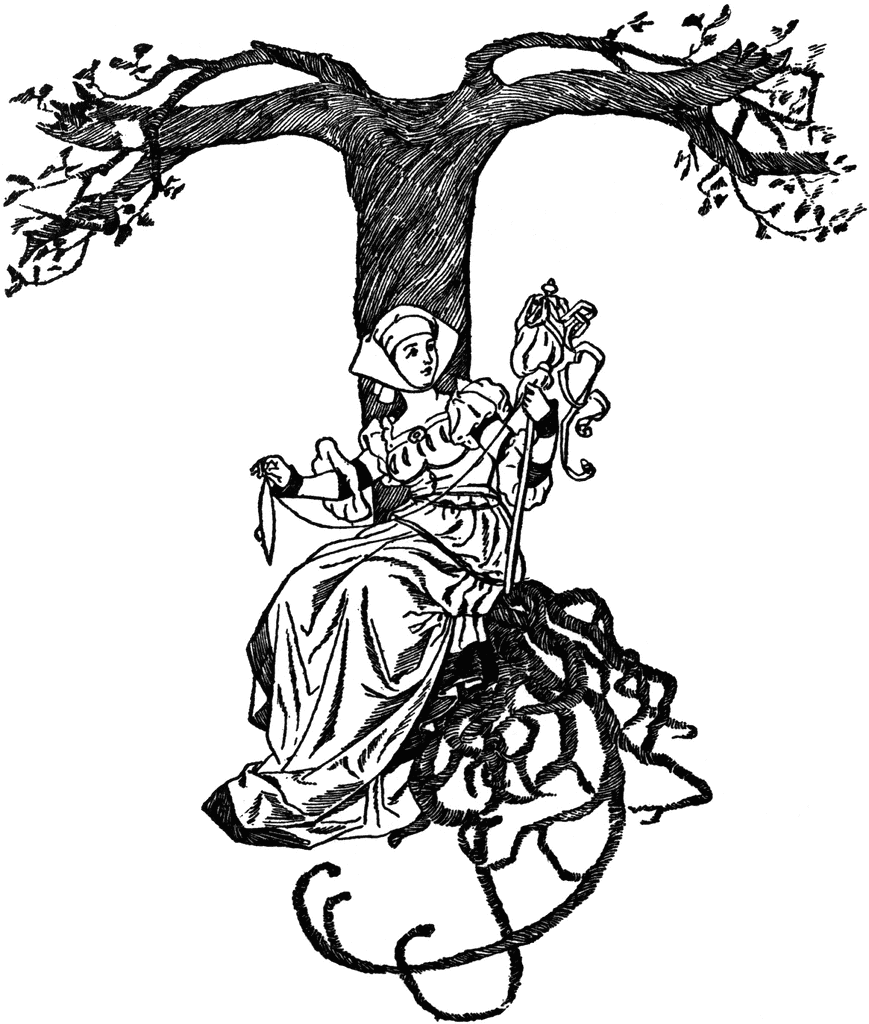
distaff image found here:
January 4th: Distaff Day
“ Partly Work, partly play
Ye must on St. Distaff’s Day……
…..If the maids a spinning go,
burn the flax and fire the tow…..”
A quote from Robert Herrick

Among the pre-industrial era, this day is known as the ‘distaff, or rock day” as distaff pertains to weaving. This was the time women went back to doing all the regular work of maintaining the home during the winter.
Especially during the 14th century when all spinning was done with distaff and spindle, in English to say “distaff side” was to denote heritage as it counted from the woman’s side of the family.  In Scandinavia the stars in Orion’s belt was called “ Friggjar rockr, "Frigg’s distaff".

Weaver, Weaver weave her thread,
Whole and strong into your web
Healer, Healer, heal her pain,
In love may she return again"

"Weaver, Weaver"---Starhawk (found here)

The distaff is a very powerful woman’s symbol, along with any of the tools of weaving, including: the loom,the spindle, and the scissors . There are many Goddesses from all the pantheons with whom the power of life and death rests who were weavers. Even many who were Goddesses of War. 
There is within the Greek legends the story of Arachne and Athena who is both the Goddess of War & Weaving. And the Goddess' revenge of changing the woman who dared to attempt to best her into the 'creepy' spiders we know today. You can hear the reclaiming song here:

Of course within the Greek legends there are also the Fates who wove the web of a person's life and would choose to cut it at the appropriate time. 


Within the Egyptian legends the oldest of the mother Goddesses is Nt (Neith) who was a Goddess of weaving and war, and protectress of the Lower Kingdom, when the two kingdoms were united she became known as the Goddess the others went to seek wisdom from. to show how important she is the root word for 'being' and weaving' is the same 'nnt' according to E.A.Wallis "the Gods of the Egyptians"


The Valkyries are of course another example of the life and death aspect of the weavers, as they had heads for weights, arrows for shuttles and human entrails as their thread (gruesome stuff). The other Germanic goddess Frau Holle (the Goddess from Mother's Night) was also associated with weaving.


There are more tales of Goddess who are associated with weaving here. You can even search within each pantheon to find them.


How to Honor the Weavers:
  • You can sing the song with the lyrics found on the website.  
  • You can if you know how to spin, why not spin a bit of thread while meditating on how you are connecting to the Goddesses( i wouldn't challenge any though we've seen how that turned out with Athena..Lol, come on I had to do one)
  • If you can craft with yarn or thread, create a piece that you can dedicate to the goddess of your choice. There are patterns found here.
  • Simply meditate on how your life's paths have created your own tapestry, what must it look like, are there many colors? many different types of threads? are there snags? is there a way to improve the tapestry? adding more threads that include others? How ever you meditate on it OWN it, this is your tapestry and it's completely unique.
During the 14th century on this day, to prevent the event of spinning all the thread that was necessary for the whole families (if not the villages) clothing, from becoming a boring job; it became somewhat of a game. With men & young boys attempting to set the freshly spun thread on fire and the women would retaliate by throwing buckets of water, not just on the fire torches but on the men as well.


“ Bring in pails of water, then
let the maids bewash the men
give St. Distaff all the night
ten bis christmas sport goodnight
and next morrow everyone
to his own vocation”
----Robert Herrick

How to Celebrate:
Today was also a day to divine the future: in the older days, and still in some parts of Finland, they do lead pouring. 
  • Which was the meting down of lead 9the pieces used for smoldering things, can be used) it was then melted, 
  • and then poured into a bucket of water, after the steam cleared, the shape of the lead would be read to determine the outcome for the following months.
  •  if the shape couldn't be read, once it cooled it would be held up in front of a candle and the shapes created by the shadows would be read.

Don’t have random bits of smoldering lead laying about? Then candle wax will do the same, you can always remelt into a candle at the end.(great way to recycle those odd bits of candles you have left over).


However you enjoy today, have a Blessed Distaff day
Be Blessed


Wednesday, 29 December 2010

12 days of Mithra-mas day 5:

December 30th Bringing in the Boar
wildboar

Then the grim boar's head
frowned on high
crested with bay & rosemary
Sir Walter Scott Marion

This has to be one of my favorite days of the Yule countdown. When I was younger my mother was big into making an amazing Boar head from pineapples, with cheese, cherries, & some of course ham. More on that later.
During Middle ages, where some of our traditions of Yule stem from, the hunting of the wild boar, was an event not to be missed. The boar plays a prominent part in many of the Yule traditions due to the wild boars territory; the boar (which is the ancestor of domesticated pigs) roamed most of Europe, some parts of the middle East & into parts of Africa. 

The Celts highly valued the boar in myths, as it was sacred to the Goddess Arduinna.  One of the more popular stories include the tale of Finn McCool (Finn mac Cumhaill) who lures his rival to his death of being gored by a boar. Within the Arthurian legend the great magician Merlin is said to have given one of his greatest compositions & addressed it to a pig.

In the Scandinavian tradition there are two great boars; one which Freyja rides called Hildesvini which means battle swine when she wasn't riding her chariot.  She even used the guise of a boar to hide one of her protege.  The second boar belongs to Freyr named Gullinbursti which meant Golden mane. This was due tot he fact that the boar was created for Freyr by a dwarf, the boar's mane or bristles would glow in the dark allowing his owner to see.

There is of course the two boars listed with the Greek mythology as well. One which Hercules had to kill as one of his 12 Labors and the other boar, called the Calydonian Boar which was hunted by many of the greats from Greek myths including the huntress Atalanta.  here also we find the shape of the boar being used to kill someone, as Ares the god of war takes this shape to kill his son, in a jealous rage.

The boar is much revered as a Christmas meal because it was one of the few animals that didn't hibernate over the winter which meant there was still meat to be had during the harsh months.  There are many tales of the roasting of boar meat for instance in the Welsh story of  Gofannon's Feast, there is the boar that is consumed but never finished and would replenish as long as the bones weren't eaten. There are even still traditions in Queen's College Oxford where the boar's head is ceremonially paraded around to the accompanied by the singing of a carol.  
There is of course that awesome first line from this carol:(which I remember attempting to sing but never getting the right words)
there was a pig, went out to dig
Christmas day, christmas day
There was a pig went out to dig
on Christmas day on christmas day

Honoring the Boar
One of the ways to honor the boar would be to have either an image or a symbol of the boar on your altar.
You can also leave out an apple or an orange at your back door for the great pig to feast on.

Making a Boar's Head
This is great for those that don't eat meat as well as those that do, simply modify the recipe, by changing the snacks you place on the sticks.
  • Cut in half a pineapple, remove the inner core then place back together.
  • My mother cuts criss-cross pattern (creates a grid pattern) then placed toothpicks filled with cheese, ham, olives, or cherries all over.
  • Cut off the top of the pineapple & create a snout with orange and cherries for eyes, for the tail you can use licorice, or use a twizzler which has been frozen into the curly shape.

You can then bring in the platter with much fanfare, of singing & dancing.

Information from Winter Solstice by John Matthews, and Wikipedia.com boar image courtesy of bing.com/images.
Celebrate with fanfare the bringing in of the boar
Be Blessed